DISTRIBUTOR BUYING GUIDE
Roofing Underlayment Delivery: A Receiving Checklist for Distributors
Check delivered roll quantities, keep batch and damage records, and resolve exceptions before underlayment stock loses its identity.
A truck can arrive with the right pallet count and still leave a receiving team with unanswered questions. Are all the rolls the ordered grade? Is a torn wrapper hiding damage? Can the warehouse identify the affected stock after it has been split between branches?
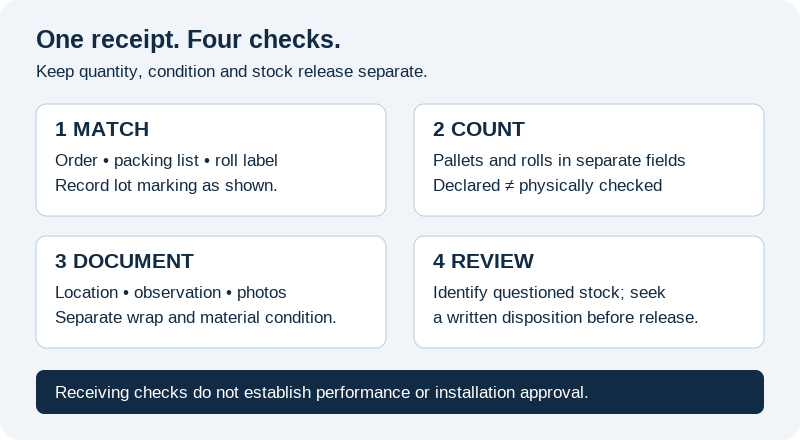
Use one receiving record to connect the purchase order, shipment, product labels and any exception. Keep counting, condition checks and release for sale as separate decisions. An intact wrapper is not a performance test, and a damaged wrapper does not establish the condition of every roll inside.
Prepare the record before unloading
Have the purchase order, order confirmation and packing list available. Compare the product description, roll dimensions, quantity and agreed packing arrangement. Use the arrangement confirmed for that shipment rather than assuming every grade has the same rolls per pallet.
Assign a receipt ID that the warehouse and purchasing team can both use. Include the delivery date, carrier reference and warehouse location. Leave a field for the lot or batch marking exactly as it appears; if none is visible, record that fact and request identification rather than inventing a number.
For a new buying program, agree on the receiving documents during the RFQ stage. A photograph of a sample label can help your team know what to look for, but it does not replace the shipment's own labels.
Count the units you can actually verify
Record pallets and rolls in different fields. A pallet count is not a roll count. If the packing list states a quantity that cannot yet be checked without safely opening the pack, label it as the declared quantity and record when a physical count will occur.
Here is a fictional receiving example, not a RIDGELOCK packing specification: a packing list calls for three pallets with 40 rolls each. Two pallets can be counted at 40 rolls; the third is still wrapped. The record should show two confirmed counts and one declared count awaiting verification, not 120 independently checked rolls.
Do not convert a roll count into usable roof coverage. Order quantity and project coverage are different calculations; see gross versus installed coverage.
Describe exceptions so another person can find them
Use a pallet position, label or temporary warehouse tag to identify affected stock. Describe what is visible, how many units are involved and what remains unverified. Keep packaging observations separate from observations of the material itself.
| Observation | Useful receiving note | Still to establish |
|---|---|---|
| Torn outer wrap | Pallet C, lower-right corner; outer wrap torn; photo C-01 | Condition and count of rolls behind the tear |
| Distorted roll end | Two rolls on pallet B have visibly compressed ends; photos B-02 and B-03 | Material condition and written disposition |
| Damp packaging | Packaging on pallet A feels damp; photo A-04 | Cause, extent and condition of enclosed material |
| Different label | One roll label differs from the ordered description; photo D-01 | Product identity and whether substitution was agreed |
These are suggested record formats, not findings about a real shipment. Avoid diagnosing a cause from a photograph alone. Keep questioned stock identifiable and out of routine picking until the responsible team has decided its disposition. A receiving note does not approve installation, establish a defect or decide who pays.
Keep the evidence together
Build a small photo set: the overall pallet, its identifying label, the packaging condition and a close view of each visible exception. Add a scale where useful and safe. Photograph before repacking, then record any later movement or unpacking so the sequence remains clear.
Carrier procedures differ. As one example, FedEx's claims guidance asks for the tracking or PRO number and supporting evidence, and says to retain original packaging for possible inspection until the claim is resolved. Check the procedure for the actual carrier and service used. Notify the relevant parties promptly; do not assume that a deadline found for another shipment applies to yours.
Send purchasing one organized exception report: receipt ID, order reference, affected quantity, label details, observations and photo filenames. Ask for written instructions on the next step. Keep the material and packaging available as required by the applicable process, while following safe warehouse practices.
Keep storage instructions product-specific
Do not use an installed roof exposure allowance as permission to leave unopened stock outdoors. Obtain the current storage and handling instructions for the exact product, including any limits on orientation, stacking, temperature and packaging.
For example, an Owens Corning technical bulletin for its self-adhered underlayments calls for dry, shaded indoor storage and keeping rolls packaged until application. That is guidance for those products; its storage arrangement and stacking provisions are not specifications for RIDGELOCK material. Request the applicable documents through our document hub.
Close the record before stock loses its identity
Record who reviewed the exception, the decision date and the written instruction reference. Distinguish a request for information from approval to release stock. If material goes to another branch, carry the receipt and lot references into the transfer record.
Use the blank receiving record as a starting point. It has fields for declared and checked quantities, observations, evidence and disposition. It does not set acceptance tolerances, claim deadlines or warranty terms.
Planning an underlayment order? Contact RIDGELOCK PRO with the product, quantity, destination and documents your receiving team needs. Product identity, packing and commercial terms should be confirmed in writing for the order.
Sources and scope
Reviewed November 15, 2026 against the RIDGELOCK document request hub and Sample review guide. Original warehouse checklist; it does not establish acceptance tolerances, product performance, installation approval, carrier liability, warranty or claim deadlines. See the carrier and product-specific references in the article. This page cites third-party guidance as an example, not a RIDGELOCK specification.