DISTRIBUTOR BUYING GUIDE
Roofing Underlayment Coverage: Why Roll Area Is Not Installed Coverage
Roll dimensions give you a starting point. Laps, cuts and roof details determine the job-specific installed estimate.
What the roll label measures
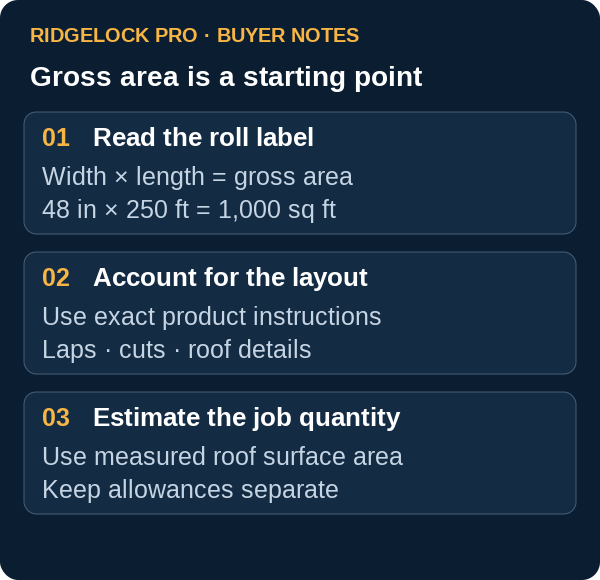
A roll marked “1,000 sq ft” gives you the nominal area from its width and length. For the current RL standard format, 48 inches is 4 feet; 4 feet × 250 feet equals 1,000 square feet of gross roll area. The published RL format is woven polypropylene at 100 GSM, 48 in × 250 ft, with 64 rolls per standard pallet.
That is the material area before the installation layout is applied. It is not a promise that a roll covers 1,000 square feet of finished roof. Laps, cuts and details use material, and the required layout depends on the product instructions and the roof assembly.
See the current synthetic underlayment format and order references.
Build a job-specific estimate
Start with the physical roll format, then use the installation instructions for the exact product and roof covering. Side laps and end laps, valleys, hips, ridges, penetrations and starter details can affect how much material the layout uses. Roof slope and the selected system may also change the prescribed layout.
- Identify the exact product. Do not assume two products with the same category name share instructions.
- Record width and length. Calculate gross area from the roll dimensions rather than relying on a shorthand “square” description.
- Check the applicable instructions. Confirm laps, fastening pattern, exposure limits and any roof-system requirements for that item.
- Mark the roof details. Include transitions, valleys, ridges, hips, eaves and penetrations in the takeoff.
- Show assumptions separately. Keep gross area, estimated installed coverage and any extra-material allowance as distinct values.
Do not apply a universal waste percentage to every roof. If an allowance is needed for a project, state the layout and assumptions used.
A simple quantity check
Suppose a measured roof surface is 2,400 sq ft. Dividing by a 1,000 sq ft gross roll gives 2.4 rolls; rounding up gives three rolls before any installation layout is considered. That is a gross-area arithmetic check, not a purchase recommendation. Do not use the building footprint in place of measured sloped roof area.
For illustration, a project takeoff that already includes laps and details might call for 2,650 sq ft of material. Round 2,650 ÷ 1,000 up to three rolls. This example is not a recommended lap allowance. Do not add the same allowance again to a takeoff that already includes it.
For stock planning, one confirmed RL pallet contains 64 standard rolls: 64,000 sq ft of gross material area. A job quantity and a branch stocking quantity remain separate decisions.
Compare coverage on the same basis
When two suppliers quote different roll formats, price per roll alone can hide a coverage difference. Compare width, length and gross area first. If a quote also gives an installed-coverage estimate, ask which laps, roof details and instructions were used.
| Figure | What it means | What it does not mean |
|---|---|---|
| Roll width and length | The physical format of the material | Net area after the installation layout |
| Gross area per roll | Nominal area calculated from those dimensions | A guaranteed finished-roof takeoff |
| Installed-coverage estimate | A project estimate based on the selected layout and instructions | A reusable figure for every roof |
GAF notes that underlayments can differ in installation procedures and advises users to follow the applicable instructions closely. The product manufacturer’s instructions and project requirements should guide the takeoff.
Ready to compare offers? Use the wholesale underlayment RFQ checklist to keep the format, quantity, destination and document scope beside the price.
Buyer questions
Does a 1,000 sq ft roll cover 1,000 sq ft of roof?
Should I use a universal waste percentage?
What should a quote show?
Sources and editorial scope
- RIDGELOCK PRO — synthetic underlayment format and order details
- GAF — synthetic underlayment overview and installation FAQ
Editorial source check: 2026-10-27. The 100 GSM, roll dimensions, gross area and pallet quantity above are current published RL references, not a general industry standard. This guide does not assign a waste factor, exposure period, performance classification or installation approval.