DISTRIBUTOR BUYING GUIDE
What to Include in a Wholesale Roofing Underlayment RFQ
A complete quote request makes it easier to compare the same product, order scope and delivery terms across suppliers.
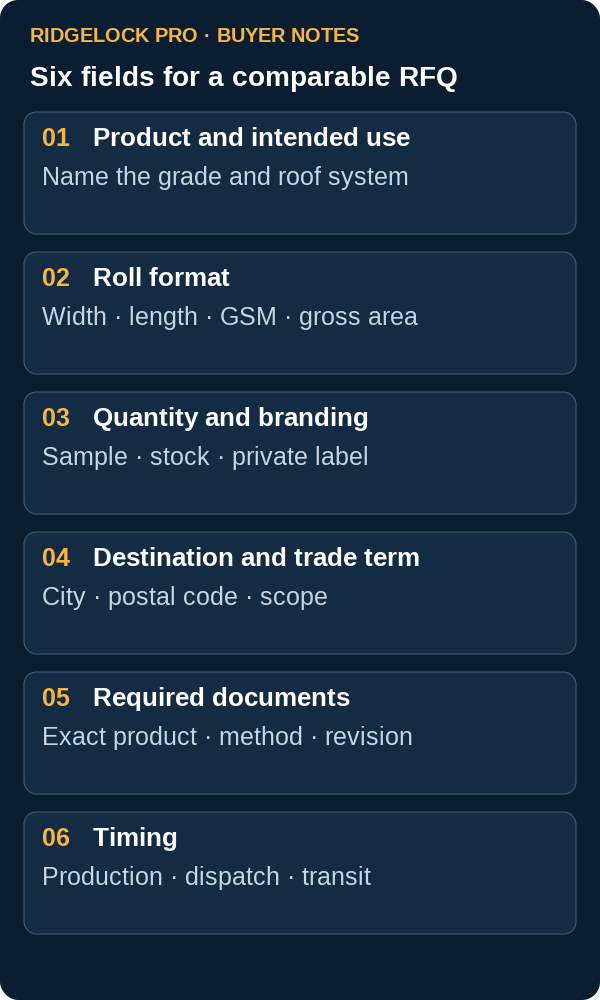
Define the product and roll
A request that only says “please quote roofing underlayment” leaves suppliers to make different assumptions. Name the material family and intended use. Attach a project specification or product data sheet if one applies. If you need a particular test report, acceptance or installation document, name it and ask the supplier to confirm it applies to the exact item.
Give the roll width, length, nominal grammage and coverage basis you want to compare. The current published RL reference is 100 GSM woven polypropylene in a 48 in × 250 ft roll, with 1,000 sq ft gross coverage. That describes one RL format; it is not an industry-wide default, and gross area is not installed coverage.
Review the current RL product and order references.
If roll labels and the job estimate do not match, check gross versus installed underlayment coverage before deciding how many rolls to order.
Separate quantity and branding
State whether the request is for a sample evaluation, a project quantity, a first stock order or a private-label production run. If you want private label, say whether the artwork is ready and what packaging or print requirements you have. Ask the supplier to confirm the minimum quantity and the scope included in setup.
The current RL page lists a standard order minimum of one pallet with 64 rolls and private-label production from six pallets. It also lists typical production of 25–30 days after artwork approval; dispatch and transit are quoted separately. Treat these as RL references for the stated product, and reconfirm the exact item and schedule in your quotation.
Specify destination, documents and timing
Include the delivery city and postal code or destination port, receiving constraints and requested trade term. State whether you are asking for FOB, CIF, DDP or another basis, then ask which costs and responsibilities are included. “Delivered” is not enough detail to compare offers with different destinations or terms.
List the product documents your team actually needs: for example, product data, test reports, installation instructions, packaging details or traceability information. A report for a different construction or brand does not establish the quoted item’s properties. Ask the supplier to identify the exact document version and product it covers.
Give the requested arrival date if you have one. Ask the supplier to separate production timing from dispatch and transit, and to identify what remains subject to confirmation.
Copyable RFQ and buyer questions
Use this as a starting point and change it to match your specification:
We are reviewing [product family] for [roof system / customer use]. Please quote [roll width × length, grammage and required documents] for [quantity and order type], delivered to [city, postal code, country] on [requested trade term]. Branding: [plain / private label; artwork status]. Please identify the product, gross coverage, pack or pallet details, documents, production timing, dispatch and transit separately. Target arrival: [date / not set].
What should a wholesale underlayment RFQ include?
What if I do not know the exact roll format?
Does a complete RFQ guarantee a price or ship date?
When replies arrive, compare them against the same product scope, quantity and destination. Leave any unconfirmed item visible instead of ranking unlike offers as if they were equivalent.
Give the counter team one comparison sheet
Download the blank RFQ comparison template (CSV). It keeps dimensions, gross coverage, order quantity, destination, documents and production/dispatch/transit on separate lines. Open it in a spreadsheet or send the same questions to each supplier.
Record an unanswered field as “to confirm.” A quote with a lower roll price can still cover a different format, leave freight open or omit a document your customer needs. Resolve those differences before treating the offers as comparable.
Sources and editorial scope
- RIDGELOCK PRO — synthetic underlayment specification and order references
- RIDGELOCK PRO — current quote request fields
Editorial source check: 2026-10-27. RL product dimensions, minimum quantities and lead-time wording are published references for the stated offer; reconfirm the exact product and terms in the quotation. This template does not promise price, availability, compliance, production completion or delivery.