ROOFING BUYING GUIDE
Reroofing With Old Underlayment Stuck to the Deck: A Prep Checklist
What to document when old roofing layers are fused or stuck during a reroof: identify the existing material, inspect the deck, and follow the selected product’s exact instructions.
During tear-off, an old membrane or roofing layer may be bonded so firmly that removing every trace would damage the deck or add substantial labor. Online answers often jump straight to “leave it” or “strip it all.” Neither is a universal rule. The correct preparation depends on what remains, the condition of the roof deck, the new roofing assembly, local requirements, and the written instructions for the exact products selected.
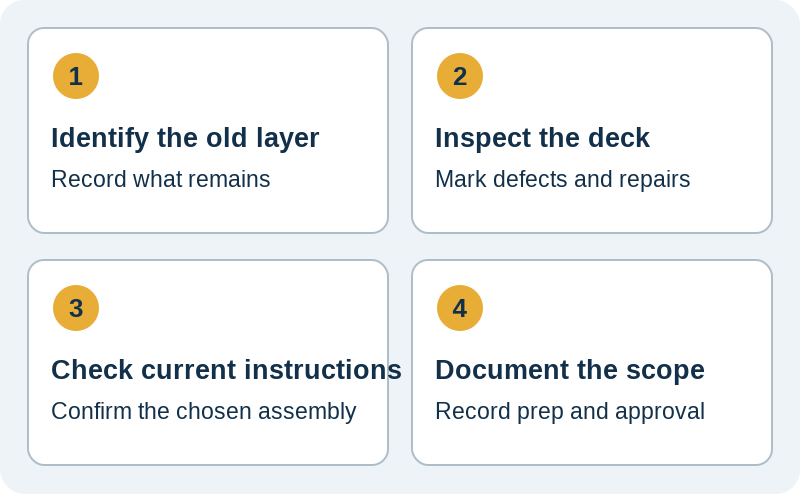
Ask the roofer to record what remains on the deck before the new material is selected or the old layers are concealed.
Start with the product instructions
Instructions can differ by product and intended assembly. For example, Owens Corning’s RhinoRoof High-Temp instructions call for removing old roofing down to the deck and applying the product to a clean, smooth, dry surface. Its RhinoRoof Anchor Sheet instructions describe a separate use case that includes certain recover conditions where an existing self-adhered layer cannot be removed, with additional steps and follow-on materials. These are manufacturer-specific examples, not directions for other products. High-Temp instructions · Anchor Sheet instructions
Do not transfer one product’s exception to another roll, brand, or roof assembly. Get the current instructions for the exact item number and read the reroofing or recover section. If the instructions do not address the condition on site, ask the manufacturer or responsible design professional before covering it.
Five items to settle before ordering
1. Identify what is actually left
Record whether the remaining material appears to be felt, a self-adhered membrane, old shingle residue, coating, or an unknown layer. Photograph representative areas and transitions. If the material cannot be identified confidently, flag it for the roofer or manufacturer rather than guessing from color or texture.
2. Document the deck condition
Have the roofer inspect for soft, wet, delaminated, damaged, or uneven decking and note repairs separately. A new underlayment does not correct a compromised substrate. The selected product’s instructions determine the required surface condition; local rules and the roof-covering manufacturer may impose additional requirements.
3. Define removal and preparation scope
Write down what will be removed, what may remain, how loose edges or debris will be handled, and what “smooth and clean” means for the chosen product. If removal could damage the deck, put the proposed alternative in writing and obtain product-specific acceptance before work proceeds. This avoids treating a field decision as an approved assembly after the roof is already covered.
4. Confirm the complete new assembly
List the new roof covering, underlayment item number, deck, attachment method, and any separate membrane or cover layer. Check which layer goes where and whether the instructions permit installation over the documented existing condition. If components are selected from different manufacturers, ask each party what compatibility evidence applies to the combined assembly.
5. Record weather protection and inspection points
If the project will be exposed between tear-off and roof-covering installation, confirm the temporary protection plan and the selected underlayment’s permitted exposure limits. NRCA cautions that underlayment used as temporary weather protection should be treated as short-term and that leak risk needs attention; exposure time is product-specific. NRCA: Using underlayment as a temporary roof
Reroof scope checklist
Ask the contractor to include these points in the work order or change order:
- Existing layers observed and areas photographed
- Deck inspection findings and allowance/approval process for repairs
- Material to be removed and material proposed to remain
- Exact new underlayment item and current installation-document revision
- Written preparation requirement for the observed substrate
- Required separation layer, membrane zones, and fastening method
- Temporary weather protection and maximum permitted exposure
- Inspection hold point before the new roof covering conceals the deck
For distributors, the same information helps keep a product substitution from being presented as a field-approved detail. RIDGELOCK’s receiving checklist and spec-sheet checklist provide procurement records, but project-specific installation decisions belong to the roofer and the applicable manufacturers.
When to pause
Pause ordering or installation if the remaining layer is unidentified, the deck shows damage, current instructions do not cover the proposed condition, or the roofer and covering manufacturer give conflicting directions. Get a written answer tied to the exact product and project. Do not rely on an informal online reply to approve a concealed roof assembly.
Sources and scope
This checklist is for project scoping and purchasing communication. It is not a removal method, code interpretation, or permission to install over an existing layer. Follow local code and current instructions for the selected roofing system. Owens Corning documents cited above apply to their named products only. RIDGELOCK product specifications do not replace those approvals; see the current synthetic underlayment information and request the applicable documents for a specific project.